

Table of Contents
ToggleWhat is Montessori? This question leads millions of parents to discover an educational approach that’s been shaping young minds for over a century. Montessori education puts children at the center of their own learning journey. Instead of rows of desks and teacher-led lectures, students explore hands-on materials at their own pace. The method encourages independence, curiosity, and a genuine love for learning. Whether you’re researching preschool options or considering a switch from traditional schooling, understanding the Montessori method helps you make an informed choice for your child’s future.
Key Takeaways
- Montessori education is a child-centered approach developed by Dr. Maria Montessori in 1907 that encourages hands-on learning, independence, and natural curiosity.
- Mixed-age classrooms (spanning three years) allow younger children to learn from older peers while older students reinforce knowledge through teaching.
- Children in Montessori programs choose their own activities and work at their own pace during uninterrupted three-hour blocks, building intrinsic motivation and deep focus.
- Research shows Montessori students often demonstrate stronger gains in reading, math, and social skills compared to peers in traditional programs.
- The prepared environment features child-accessible materials designed for self-correction, helping students develop problem-solving skills without constant adult intervention.
- Visit Montessori classrooms in action and observe how children engage with materials to determine if the approach is right for your child.
The Origins and Philosophy of Montessori Education
Dr. Maria Montessori developed this educational approach in Rome during the early 1900s. She was Italy’s first female physician, and her medical background shaped how she observed children’s learning behaviors. In 1907, she opened her first classroom, Casa dei Bambini (Children’s House), in a low-income district. What she discovered there surprised the educational world.
Montessori noticed that children learn best when they choose their own activities. She observed that young learners have natural periods of intense focus. When given the right environment and materials, children taught themselves reading, writing, and mathematics without traditional instruction.
The Montessori philosophy rests on a simple belief: children are naturally eager to learn. Adults don’t need to force knowledge into them. Instead, teachers create prepared environments where learning happens organically. This stands in contrast to conventional education, where adults decide what children should learn and when.
Montessori also introduced the concept of “sensitive periods.” These are windows of time when children show heightened interest in specific skills. A toddler obsessed with sorting objects, for example, is in a sensitive period for order. Montessori classrooms capitalize on these natural tendencies rather than fighting against them.
Core Principles of the Montessori Method
Several key principles define what Montessori education looks like in practice.
Child-Led Learning
Students choose their activities from a range of options. A child might spend an hour with math materials one day and focus entirely on geography the next. This freedom builds intrinsic motivation. Children work because they want to, not because someone told them to.
Mixed-Age Classrooms
Montessori groups children in three-year age spans. A typical classroom might include 3 to 6-year-olds together. Younger children learn from older peers. Older children reinforce their knowledge by teaching concepts to younger ones. This mirrors real-world social structures more closely than same-age groupings.
Hands-On Materials
Montessori classrooms use specialized learning materials designed for self-correction. A child working with math beads can see immediately if they’ve made an error. They don’t need a teacher to tell them. This builds problem-solving skills and independence.
Uninterrupted Work Periods
Children typically have three-hour blocks of uninterrupted work time. This differs sharply from traditional schools where bells ring every 45 minutes. Long work periods allow deep concentration and sustained focus, skills that benefit learners throughout their lives.
The Prepared Environment
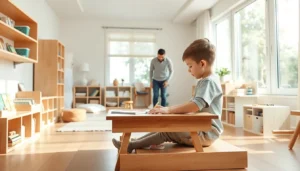
Every element in a Montessori classroom serves a purpose. Materials sit on low shelves within children’s reach. Furniture fits their bodies. Beauty and order characterize the space. This environment invites exploration and respects children’s capabilities.
What a Montessori Classroom Looks Like
Walk into a Montessori classroom and you’ll notice something different right away. There’s no teacher standing at a chalkboard. Instead, you’ll see children scattered throughout the room, each engaged in different activities.
One child might sit on a small rug, carefully pouring water between pitchers. Another works with wooden letter shapes, tracing their forms with her fingers. A group of older students discusses a continent they’re studying while examining a puzzle map.
The teacher, called a “guide” in Montessori terms, moves quietly around the room. She observes, takes notes, and offers individual lessons when a child seems ready for new material. She doesn’t interrupt a child who’s deeply focused. That concentration is considered sacred.
Montessori materials look beautiful and inviting. You’ll find wooden blocks, brass bells, colorful beads, and practical life tools like child-sized brooms and real glass pitchers. These aren’t toys. Each material teaches a specific concept and builds toward more abstract understanding.
The classroom divides into distinct areas: practical life, sensorial, mathematics, language, and cultural studies. Children move freely between these areas based on their interests. There’s a quiet hum of activity rather than rows of students doing the same worksheet.
Benefits of Montessori Education for Children
Research supports many benefits of the Montessori approach. A 2017 study published in Frontiers in Psychology found that Montessori students showed greater gains in reading, math, and social skills compared to peers in traditional programs.
Independence and Self-Discipline
Montessori children learn to manage their time and make decisions early. They choose activities, complete work cycles, and return materials to shelves without constant adult direction. These habits translate into strong executive function skills.
Love of Learning
Because children follow their interests, they develop genuine curiosity rather than viewing education as a chore. Many Montessori graduates describe themselves as lifelong learners.
Social Development
Mixed-age classrooms create natural opportunities for mentorship. Children practice patience, communication, and cooperation daily. Conflict resolution happens organically as children learn to share space and materials.
Academic Achievement
Montessori students often perform at or above grade level in standardized assessments. The hands-on approach builds concrete understanding before abstract concepts, creating a strong foundation.
Creativity and Problem-Solving
The open-ended nature of Montessori work encourages creative thinking. Children learn there’s often more than one way to solve a problem. They’re not afraid to make mistakes because errors are part of learning.
Is Montessori Right for Your Child?
Montessori education works well for many children, but it’s not a universal fit. Understanding both its strengths and potential challenges helps families decide.
Children who thrive in Montessori often share certain traits. They enjoy working independently and show curiosity about how things work. They respond well to having choices rather than constant direction.
Some children prefer more structure. A child who needs explicit instructions at every step might feel lost in a Montessori environment initially. But, many of these children adapt beautifully with time and patient guidance.
Parent involvement matters too. Families who understand and support Montessori principles at home see better outcomes. This might mean allowing children to dress themselves (even if it takes longer) or involving them in real household tasks.
Cost can be a factor. Private Montessori schools often carry significant tuition fees. But, public Montessori programs exist in many districts. Some families apply Montessori principles at home regardless of where their children attend school.
The best way to determine fit? Visit Montessori classrooms in action. Observe how children interact with materials and each other. Talk to teachers and parents. Watch how your child responds to the environment.