

Table of Contents
ToggleMontessori vs traditional education, it’s a decision that keeps many parents up at night. Both approaches shape how children learn, play, and grow. But they do so in remarkably different ways. One emphasizes child-led discovery. The other follows a structured, teacher-directed path. Neither is inherently better. The right choice depends on your child’s personality, learning style, and your family’s values. This guide breaks down the key differences between Montessori and traditional schooling, explores the pros and cons of each, and helps you determine which approach fits your child best.
Key Takeaways
- Montessori vs traditional education differs fundamentally—Montessori emphasizes child-led discovery while traditional schooling follows a teacher-directed, structured approach.
- Montessori classrooms feature mixed-age groupings, self-paced learning, and hands-on materials, whereas traditional schools use same-age grades and standardized curricula.
- Montessori fosters independence and intrinsic motivation, but may lack structure some children need; traditional education offers clear benchmarks but can limit self-directed exploration.
- When comparing Montessori vs traditional options, observe your child’s learning style—some thrive with freedom while others need explicit direction and boundaries.
- Visit both types of schools, talk to other parents, and consider practical factors like availability and cost before making your decision.
- No choice is permanent—children are adaptable, and you can switch approaches if one isn’t working for your family.
What Makes Montessori Education Unique
Montessori education centers on one core belief: children learn best when they direct their own learning. Dr. Maria Montessori developed this method in the early 1900s after observing how children naturally explore their environment.
In a Montessori classroom, students choose their activities from a range of options. A child might spend an hour working with math manipulatives, then move to a reading corner, then practice pouring water between containers. This freedom isn’t random, it’s guided by carefully designed materials that teach specific concepts.
Mixed-age groupings are another hallmark of Montessori vs traditional settings. A typical Montessori classroom includes children spanning three years (ages 3-6, 6-9, or 9-12). Older students mentor younger ones. Younger students observe and learn from their peers.
Teachers in Montessori schools serve as guides rather than lecturers. They observe each child, introduce new materials at the right developmental moment, and step back to let learning happen. There are no grades, no tests, and no assignments in most Montessori programs. Progress is measured through observation and individual assessment.
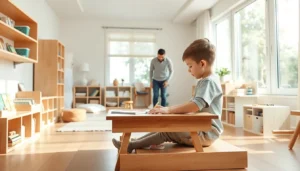
The physical environment matters too. Montessori classrooms feature child-sized furniture, natural materials, and open shelving where students can access learning tools independently. Everything has a purpose. Everything has a place.
How Traditional Schooling Differs
Traditional education follows a teacher-centered model. The teacher stands at the front of the room, delivers lessons to the whole class, and students absorb information together. This structure has existed for centuries and remains the dominant approach in public and private schools worldwide.
In traditional classrooms, students sit in rows or groups, facing the teacher. They follow a set curriculum with specific subjects taught at specific times. Math happens at 9 AM. Reading at 10 AM. Everyone works on the same material, regardless of individual readiness.
Age-based grade levels define traditional schooling. A six-year-old enters first grade. A ten-year-old is in fifth grade. Students advance together each year, moving through standardized benchmarks.
Assessment in traditional schools relies on tests, quizzes, and grades. Report cards arrive quarterly. Assignments reinforces classroom lessons. These metrics provide clear, comparable data on student performance.
Teachers in traditional settings manage the classroom, enforce rules, and ensure all students meet learning objectives. Direct instruction dominates. Students raise their hands to speak, follow schedules, and complete assigned work.
This structure prepares children for standardized testing and provides a familiar framework for parents who experienced the same system themselves.
Key Differences in Teaching Methods and Classroom Structure
The Montessori vs traditional debate comes down to fundamentally different philosophies about how children learn.
Learning Pace: Montessori allows each child to move at their own speed. A four-year-old reading at a second-grade level can access advanced materials. A six-year-old still mastering number concepts can take the time needed. Traditional schools expect all students to progress together, which can bore advanced learners or frustrate those who need more time.
Classroom Layout: Montessori rooms look like workshops. Students spread across the floor, work at tables, or sit in quiet corners. Traditional classrooms arrange desks facing a whiteboard, with students seated for most of the day.
Role of the Teacher: Montessori teachers observe and guide. Traditional teachers instruct and evaluate. Both approaches require skilled educators, but the skills differ. A Montessori guide must recognize developmental readiness. A traditional teacher must deliver curriculum effectively to diverse learners simultaneously.
Social Dynamics: Mixed-age Montessori classrooms encourage collaboration across developmental stages. Same-age traditional classrooms build peer relationships and shared experiences within a cohort.
Assessment Methods: Montessori uses observation and narrative reports. Traditional education relies on grades and test scores. Parents comfortable with numerical benchmarks may find traditional assessments more transparent.
Daily Structure: Montessori offers three-hour uninterrupted work periods. Traditional schools divide the day into shorter subject blocks with transitions between activities.
Pros and Cons of Each Approach
Montessori Advantages
- Fosters independence and self-motivation
- Respects individual learning pace
- Develops critical thinking and problem-solving skills
- Encourages intrinsic love of learning
- Builds strong executive function skills
Montessori Disadvantages
- Less structure may challenge some children
- Transition to traditional schools can be difficult
- Availability is limited in many areas
- Tuition costs can be high for private programs
- Inconsistent quality among schools using the Montessori name
Traditional Education Advantages
- Familiar structure for parents and students
- Clear expectations and measurable outcomes
- Prepares students for standardized testing
- Widely available through public school systems
- Easier transitions between schools
Traditional Education Disadvantages
- One-size-fits-all approach may not serve all learners
- Limited opportunity for self-directed exploration
- Can emphasize compliance over curiosity
- Less flexibility for advanced or struggling students
- Heavy reliance on external motivation (grades, rewards)
When weighing Montessori vs traditional options, consider what your child needs most. Some kids thrive with freedom. Others need clear boundaries and explicit direction.
Choosing the Best Fit for Your Child
The Montessori vs traditional decision isn’t about which method is superior. It’s about which approach matches your child.
Observe your child at home. Does she initiate projects independently? Does he need structure to stay focused? Does she work well with older or younger children? Does he respond better to intrinsic satisfaction or external rewards?
Visit schools. Spend time in both Montessori and traditional classrooms. Watch how teachers interact with students. Notice how children engage with materials and each other. Ask about teacher training, curriculum, and parent involvement.
Consider practical factors. What options exist in your area? What can you afford? How long might your child stay in the program? Montessori works best with continuity, starting at age three and continuing through elementary school.
Talk to other parents. Families who’ve chosen Montessori can share real experiences. Parents whose children attend traditional schools offer different perspectives. No online article replaces firsthand accounts.
Trust your instincts. You know your child better than any educational philosophy does. A child who struggles in one environment may flourish in another. And remember, no decision is permanent. Children are adaptable. If one approach isn’t working, you can change course.