

Table of Contents
ToggleMontessori techniques offer a proven approach to education that puts children in control of their own learning. Developed over a century ago by Dr. Maria Montessori, these methods remain popular because they work. They respect each child’s natural curiosity and developmental pace.
This article explains the core Montessori techniques used in classrooms worldwide. It also shows parents how to apply these same methods at home. Whether someone is new to Montessori or looking to deepen their understanding, this guide covers the practical strategies that make this approach effective.
Key Takeaways
- Montessori techniques place children in control of their learning by letting them choose activities and work at their own pace.
- The prepared environment and hands-on learning materials are two foundational Montessori techniques that foster independence and deep understanding.
- Parents can apply Montessori techniques at home by creating accessible spaces, involving children in household tasks, and following their natural interests.
- Research shows children taught with Montessori methods demonstrate stronger academic skills, better social understanding, and improved self-regulation.
- Montessori techniques build executive function skills like working memory and self-control, which predict long-term success better than IQ.
- Children who experience Montessori education often develop a lifelong love of learning by viewing education as exploration rather than obligation.
What Makes Montessori Different From Traditional Education
Traditional classrooms typically place the teacher at the center. The teacher lectures, assigns work, and controls the schedule. Students sit in rows, complete the same tasks at the same time, and receive grades based on standardized tests.
Montessori techniques flip this model. Children choose their own activities from a range of options. They work at their own pace, often for extended periods without interruption. A three-year-old might spend 45 minutes pouring water between containers while a five-year-old traces sandpaper letters nearby.
The teacher’s role changes too. In Montessori classrooms, teachers observe more than they instruct. They introduce new materials when a child shows readiness. They step back and let children discover concepts through direct experience.
Another key difference involves mixed-age groupings. Montessori classrooms typically combine children across a three-year age span. A classroom might include children ages 3 to 6. Older children reinforce their knowledge by helping younger ones. Younger children learn by watching their peers.
Montessori techniques also reject external rewards like stickers, grades, or prizes. The philosophy holds that children are naturally motivated to learn. External rewards can actually undermine this intrinsic motivation over time. Instead, the satisfaction of mastering a skill serves as the reward itself.
Core Montessori Techniques Used in the Classroom
Montessori classrooms look different from conventional ones. Everything serves a purpose. Two foundational Montessori techniques stand out: the prepared environment and hands-on learning materials.
Prepared Environment
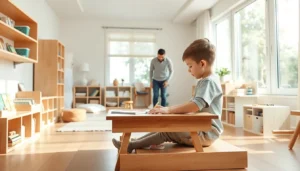
The prepared environment is a cornerstone of Montessori techniques. Every element in the classroom is intentional. Furniture is child-sized. Materials sit on low, open shelves where children can reach them independently.
The space is organized into distinct areas: practical life, sensorial, language, mathematics, and cultural studies. Children move freely between these areas. They select work that interests them and return materials to their designated spots when finished.
Order matters in Montessori environments. A cluttered space creates a cluttered mind. Teachers arrange materials from simple to complex, left to right. This organization helps children develop concentration and self-discipline.
Natural light, plants, and soft colors create a calm atmosphere. Noise levels stay low because children engage deeply with their chosen activities. The environment itself teaches responsibility, independence, and respect for shared spaces.
Hands-On Learning Materials
Montessori techniques rely heavily on specialized materials. These aren’t toys or worksheets. They’re carefully designed tools that teach specific concepts through physical manipulation.
The Pink Tower, for example, consists of ten wooden cubes ranging in size. Children stack them from largest to smallest. Through this simple activity, they absorb concepts like dimension, sequence, and visual discrimination, without a single lecture.
The Golden Beads teach mathematics through touch. Children hold single unit beads, bars of ten, squares of one hundred, and cubes of one thousand. Abstract numbers become concrete objects they can count, combine, and exchange.
Each material isolates one concept. This isolation of difficulty helps children focus on a single skill at a time. Materials also include built-in error control. Children can see their own mistakes without adult correction. A puzzle piece that doesn’t fit signals an error. This self-correction builds problem-solving skills and confidence.
How to Apply Montessori Techniques at Home
Parents don’t need a classroom full of specialized materials to use Montessori techniques. The core principles translate easily to home life.
Start by creating accessible spaces. Store toys and books on low shelves. Place a step stool near the bathroom sink. Arrange a low hook for coats. When children can access their belongings independently, they develop self-sufficiency.
Involve children in real household tasks. Montessori techniques emphasize practical life activities. A two-year-old can help fold washcloths. A four-year-old can prepare simple snacks. These activities build fine motor skills, concentration, and a sense of contribution to the family.
Follow the child’s interests. If a child loves dinosaurs, provide books, figurines, and art materials related to dinosaurs. Montessori techniques respect children’s natural curiosity. Learning happens faster when it connects to genuine interest.
Limit choices to reduce overwhelm. Instead of a playroom stuffed with toys, rotate a smaller selection. Three or four well-chosen options promote deeper engagement. Children often can’t choose when faced with too many possibilities.
Resist the urge to interrupt. When a child concentrates on an activity, let them continue. These periods of deep focus are valuable. Montessori techniques protect uninterrupted work time because that’s where real learning occurs.
Model the behavior you want to see. Children learn by observation. Speak calmly, clean up after yourself, and show respect for materials. These indirect lessons shape behavior as powerfully as direct instruction.
Benefits of Using Montessori Methods
Research supports what Montessori educators have observed for decades. Children who experience Montessori techniques often show advantages in academic and social development.
A 2006 study published in Science compared Montessori students to peers in traditional programs. The Montessori children demonstrated stronger reading and math skills by age five. They also showed better social understanding and were more likely to engage in positive play.
Montessori techniques foster independence. Children learn to dress themselves, prepare food, and solve problems without constant adult help. These skills serve them well beyond the classroom.
Self-regulation improves too. Because children choose their own activities and work at their own pace, they develop internal motivation. They learn to manage their time and attention, skills that become increasingly valuable with age.
Creativity thrives in Montessori settings. Open-ended materials encourage experimentation. There’s no single right answer to many activities. Children learn to think flexibly and approach problems from multiple angles.
Montessori techniques also build executive function skills. These include working memory, mental flexibility, and self-control. Strong executive function predicts success in school and life more reliably than IQ.
Perhaps most importantly, children who learn through Montessori techniques often develop a genuine love of learning. They see education as exploration rather than obligation. This mindset can last a lifetime.