

Table of Contents
ToggleMontessori strategies help children develop independence, focus, and a genuine love for learning. These methods, created by Dr. Maria Montessori over a century ago, remain effective in homes and classrooms today. They work because they respect children’s natural curiosity and give them the freedom to learn at their own pace.
This guide covers the core principles behind Montessori methods. It explains how to set up spaces that encourage self-directed learning. It also offers practical Montessori strategies parents and teachers can use right away. Whether a child is a toddler or a pre-teen, these approaches can make a real difference in how they engage with the world around them.
Key Takeaways
- Montessori strategies prioritize child-led learning, hands-on activities, and intrinsic motivation over external rewards.
- Prepare the environment with child-sized furniture, organized open shelves, and limited materials to encourage self-directed exploration.
- Daily routines like dressing, mealtime, and cleaning offer practical opportunities to build independence and motor skills.
- Protect children’s concentration by providing long, uninterrupted work periods and avoiding unnecessary interruptions or unsolicited praise.
- Adapt Montessori strategies to each developmental stage—from sensory play for toddlers to real-world projects for adolescents.
- Respect for the child remains the foundation of all Montessori methods, building lasting confidence and self-regulation.
Core Principles Behind Montessori Methods
Montessori strategies rest on a few key ideas. First, children learn best when they direct their own activities. Adults serve as guides, not lecturers. They observe each child and offer support when needed.
Second, hands-on learning beats passive instruction. Children touch, move, and manipulate objects. This physical engagement helps them understand abstract concepts. A child learns addition by counting beads, not by memorizing facts from a worksheet.
Third, mixed-age groups benefit everyone. Younger children watch and learn from older peers. Older children reinforce their knowledge by teaching. This setup mirrors real-world social environments.
Fourth, intrinsic motivation matters more than external rewards. Montessori strategies avoid gold stars and prizes. Instead, children feel satisfaction from completing tasks and mastering skills. This builds lasting motivation that carries into adulthood.
Finally, respect for the child shapes every interaction. Adults speak to children calmly. They give clear expectations. They allow children to make choices and experience natural consequences. This respect builds confidence and self-regulation.
Preparing the Environment for Self-Directed Learning
The physical space plays a huge role in Montessori strategies. A well-prepared environment invites children to explore and learn without constant adult direction.
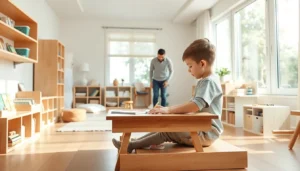
Start with child-sized furniture. Low shelves, small tables, and appropriately sized chairs let children access materials on their own. They don’t need to ask for help reaching things.
Organize materials on open shelves. Each item has a designated spot. Children can see their options clearly. They choose what interests them. When they finish, they return items to their place. This builds responsibility and order.
Limit the number of materials available. Too many choices overwhelm children. A curated selection allows deeper engagement with each activity. Rotate materials periodically to maintain interest.
Use real objects when possible. Glass cups, ceramic dishes, and metal utensils teach children to handle items with care. Montessori strategies trust children with real responsibility.
Create defined work areas. A rug on the floor marks a child’s workspace. A tray contains all materials for an activity. These boundaries help children focus and respect others’ work.
Keep the space clean and orderly. Beauty matters in Montessori environments. Plants, natural light, and attractive materials inspire children. Clutter distracts and discourages engagement.
Practical Montessori Strategies for Home and Classroom
Encouraging Independence Through Daily Routines
Daily routines offer perfect opportunities to apply Montessori strategies. Children can do far more than adults often expect.
In the morning, children can choose their own clothes. Organize drawers so appropriate options are easy to reach. A young child might pick between two outfits. An older child can select from a full wardrobe.
Mealtime invites participation. Children can set the table, pour their own drinks, and serve themselves. They can help prepare food, washing vegetables, spreading butter, or mixing ingredients. These tasks build motor skills and confidence.
Cleaning becomes part of the routine, not a punishment. Children wipe up spills, sweep floors, and fold laundry. Keep child-sized cleaning tools available. A small broom and dustpan work wonders.
Self-care tasks follow the same principle. Children can brush their teeth, wash their hands, and comb their hair. Set up bathrooms with step stools and accessible supplies.
Supporting Focus and Concentration
Montessori strategies protect children’s concentration. When a child works on an activity, adults avoid interrupting. They don’t offer unsolicited help or praise. They let the child finish.
Long, uninterrupted work periods matter. Children need at least two to three hours to settle into deep work. Short activity blocks prevent this flow state from developing.
Observe before intervening. Watch what a child struggles with. Sometimes they figure it out alone. Other times, a brief demonstration helps more than verbal explanation.
Offer activities that match the child’s skill level. Too easy bores them. Too hard frustrates them. The right challenge keeps them engaged.
Limit screen time and other distractions. Montessori strategies emphasize real-world engagement over passive entertainment. Children need quiet time to think and create.
Adapting Montessori Strategies for Different Ages
Montessori strategies change as children grow. What works for a toddler won’t suit a ten-year-old.
For infants and toddlers (birth to age three), focus on sensory experiences and movement. Provide rattles, stacking toys, and safe spaces to crawl and walk. Simple activities like transferring objects between containers build coordination.
Primary-age children (ages three to six) thrive with practical life activities. Pouring, spooning, buttoning, and cutting develop fine motor skills. Sensorial materials help them categorize the world. Language and math materials introduce early academics through concrete objects.
Elementary children (ages six to twelve) need more abstract challenges. Montessori strategies at this stage involve research projects, group work, and going out into the community. These children ask big questions about history, science, and society. They want to understand how things connect.
Adolescents benefit from real-world responsibility. They can run small businesses, manage farms, or plan community service projects. Montessori strategies for teens emphasize practical experience over classroom lectures.
At every age, the core stays the same. Respect the child. Prepare the environment. Step back and let them learn.