

Table of Contents
ToggleMontessori ideas offer parents a proven framework for helping children learn through hands-on experiences. This educational approach, developed over a century ago by Dr. Maria Montessori, emphasizes independence, self-directed activity, and respect for a child’s natural development. Parents don’t need expensive materials or special training to apply these principles at home. A few simple adjustments to the environment and daily routines can make a significant difference. This guide covers practical Montessori ideas that work for busy families, from everyday activities to age-appropriate learning strategies for toddlers and preschoolers.
Key Takeaways
- Montessori ideas focus on hands-on learning, independence, and respecting each child’s natural pace of development.
- Parents can implement Montessori activities at home using everyday items like pitchers, cloths, and household objects—no expensive materials needed.
- Creating a Montessori-friendly environment involves low shelves, limited toy choices, and child-sized furniture to encourage independence.
- Practical life skills like pouring, folding, and cleaning build concentration, coordination, and self-sufficiency in young children.
- Tailor Montessori ideas to your child’s age: toddlers thrive with sensory play and repetition, while preschoolers can handle more complex tasks and academic preparation.
- Following the child’s interests is essential—when children choose their own activities, they engage more deeply and learn more effectively.
What Makes Montessori Different
The Montessori method stands apart from traditional education in several key ways. Children learn at their own pace rather than following a rigid curriculum. They choose their activities from a prepared environment, which builds decision-making skills and internal motivation.
Montessori ideas center on a few core principles:
- Respect for the child: Adults act as guides rather than instructors. They observe and support rather than direct every action.
- Prepared environment: Spaces are organized with child-sized furniture and accessible materials. Everything has a purpose and a place.
- Hands-on learning: Children touch, move, and manipulate objects. Abstract concepts become concrete through physical experience.
- Mixed-age groupings: Younger children learn from older peers, while older children reinforce knowledge by teaching.
Traditional classrooms often prioritize group instruction and standardized testing. Montessori environments prioritize individual growth and intrinsic motivation. A child might spend 45 minutes exploring a puzzle or building with blocks, and that’s encouraged. The goal isn’t to rush through material but to develop deep concentration and genuine understanding.
This approach works because it aligns with how children naturally learn. They’re curious. They want to explore. Montessori ideas tap into that curiosity instead of fighting against it.
Simple Montessori Activities for Everyday Learning
Parents can incorporate Montessori ideas into daily routines without buying special equipment. Many effective activities use items already found in most homes.
Practical Life Skills
Practical life activities form the foundation of Montessori learning. These tasks build concentration, coordination, and independence.
- Pouring practice: Set up two small pitchers and let the child pour water or dry beans from one to the other. This develops fine motor control.
- Folding cloths: Start with simple washcloths. Children enjoy matching corners and creating neat folds.
- Preparing snacks: Spreading butter on bread, peeling bananas, or washing fruit gives children real responsibility.
- Cleaning tasks: Sweeping with a child-sized broom, wiping tables, or watering plants connects children to their environment.
Sensory Exploration
Montessori ideas emphasize learning through the senses. Try these simple activities:
- Texture boards: Glue different materials (sandpaper, fabric, cotton balls) onto cardboard. Children close their eyes and describe what they feel.
- Sound matching: Fill small containers with rice, coins, or bells. Children shake them and match pairs by sound.
- Smell jars: Place herbs, vanilla, or citrus peels in covered containers. Children identify scents using only their nose.
Early Math and Language
- Counting with objects: Use buttons, stones, or pasta to count. Physical objects make numbers real.
- Letter tracing: Form letters in a tray of sand or salt. Children trace shapes with their fingers before picking up a pencil.
- Sorting activities: Sort socks by color, toys by size, or utensils by type. Sorting builds classification skills essential for later learning.
Creating a Montessori-Friendly Environment
The physical space matters in Montessori education. A well-organized environment invites children to learn independently.
Organization Principles
Montessori ideas for the home focus on accessibility and order:
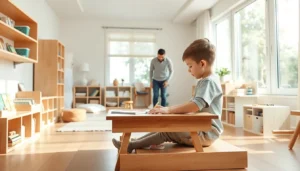
- Low shelves: Place materials on low, open shelves where children can see and reach everything. Avoid toy boxes that hide items in a jumbled pile.
- Limited choices: Rotate toys and materials. Too many options overwhelm children. Five to eight activities displayed at a time works well.
- Everything has a place: Use baskets, trays, and containers to define spaces. Children learn to return items where they found them.
- Child-sized furniture: Small tables, chairs, and step stools allow children to function independently.
Room-by-Room Ideas
Kitchen: Keep a low drawer with child-safe utensils. Place snacks on a low shelf in the refrigerator. Set up a hand-washing station at an accessible height.
Bedroom: Use a floor bed or low bed frame. Hang clothes on low hooks. Place a mirror at the child’s eye level.
Bathroom: Add a step stool for the sink. Keep a child’s toothbrush and cup within reach. Provide small towels the child can manage alone.
Play area: Display activities on open shelving. Include a small table for focused work. Keep the space calm and uncluttered.
Montessori ideas for the environment aren’t about perfection. They’re about creating spaces where children can act with independence and purpose.
Age-Appropriate Ideas for Toddlers and Preschoolers
Children’s abilities change rapidly in early childhood. Montessori ideas should match each developmental stage.
For Toddlers (12–36 Months)
Toddlers need movement and sensory experiences. They’re developing language, motor skills, and a sense of self.
Best activities:
- Object permanence boxes (dropping a ball through a hole and watching it reappear)
- Simple puzzles with knobs or large pieces
- Stacking and nesting toys
- Water play with cups and funnels
- Dancing and movement to music
- Looking at books with real photographs
Practical life tasks:
- Putting dirty clothes in a hamper
- Wiping up spills with a small cloth
- Helping load the washing machine
- Feeding pets with supervision
Toddlers repeat activities many times. This repetition builds mastery. Let them work without interruption.
For Preschoolers (3–6 Years)
Preschoolers can handle more complex tasks. They’re ready for activities that challenge their growing abilities.
Best activities:
- Cutting with child-safe scissors
- Lacing and threading beads
- Building with blocks and construction materials
- Gardening and planting seeds
- Cooking simple recipes
- Art projects with various materials
Academic preparation:
- Sandpaper letters for learning the alphabet
- Number rods and counting beads
- Matching and memory games
- Rhyming activities and word play
Preschoolers also benefit from Montessori ideas around social development. They can set the table for family meals, help younger siblings, and participate in household decisions.
The key across all ages: follow the child’s interests. When children choose their activities, they engage more deeply and learn more effectively.