

Table of Contents
ToggleA Montessori guide plays a central role in child-centered education. Unlike traditional teachers who direct lessons from the front of the classroom, a Montessori guide observes, facilitates, and supports each child’s natural learning process. This approach stems from Dr. Maria Montessori’s philosophy that children learn best when they follow their own curiosity at their own pace.
The term “guide” is intentional. These educators don’t simply teach, they guide children toward discovery. They create prepared environments, introduce materials at the right moments, and step back to let learning unfold. For parents considering Montessori education or educators exploring this career path, understanding what a Montessori guide does reveals the heart of this educational method.
Key Takeaways
- A Montessori guide facilitates independent learning by observing children and introducing materials at the right moments rather than directing lessons.
- Unlike traditional teachers, a Montessori guide works with individuals or small groups and allows children to choose their own activities.
- Core responsibilities include preparing the classroom environment, keeping detailed observation records, and building a supportive community among mixed-age students.
- Becoming a certified Montessori guide requires specialized training (1–2 years) through organizations like AMI or AMS, covering specific age groups from infants to adolescents.
- The ultimate goal of a Montessori guide is to foster independence and self-discipline, gradually making direct intervention unnecessary as children grow.
What Is a Montessori Guide?
A Montessori guide is an educator trained in the Montessori method who facilitates independent learning in children. The title reflects a fundamental shift in thinking about the adult’s role in education. Rather than standing at the front of a room delivering information, the Montessori guide works alongside children as they explore specially designed materials.
Dr. Maria Montessori developed this approach in the early 1900s after observing how children naturally engage with their environment. She noticed that children absorb knowledge more effectively when they direct their own learning. The Montessori guide supports this process by:
- Preparing an organized, accessible classroom environment
- Observing each child’s interests and developmental readiness
- Introducing new materials through individual or small-group lessons
- Allowing children to repeat activities as often as they need
- Stepping back to let children work independently
The Montessori guide views each child as a capable individual with unique strengths. This perspective shapes every interaction. When a child struggles, the guide doesn’t immediately provide answers. Instead, they might ask questions, suggest a different approach, or simply give the child more time. This builds problem-solving skills and self-confidence.
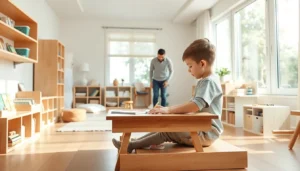
In a Montessori classroom, you’ll often see the guide sitting at a child’s level, speaking quietly, and moving with purpose. The atmosphere feels calm and focused. Children choose their own work from shelves of materials, and the guide circulates to offer support where needed.
Core Responsibilities of a Montessori Guide
A Montessori guide handles many responsibilities that traditional teachers might not recognize. The work extends far beyond lesson planning and grading.
Preparing the Environment
The classroom itself is considered a teacher in Montessori education. The Montessori guide arranges materials on open shelves in a logical sequence. Everything has a specific place. Materials progress from simple to complex, concrete to abstract. The guide maintains this order daily, replacing worn items and rotating materials based on children’s developing interests.
Observing Children
Observation is perhaps the most important skill a Montessori guide develops. Through careful watching, the guide learns when a child is ready for a new challenge. They notice which activities spark engagement and which cause frustration. These observations inform all decisions about when and how to introduce lessons.
A skilled Montessori guide keeps detailed records of each child’s progress. They track which materials a child has mastered and which ones need more practice. This documentation helps them plan individualized learning paths.
Giving Lessons
Montessori guides present lessons through demonstrations rather than lectures. They show children how to use materials with precise, slow movements. Words are minimal, the focus stays on the hands and the work. After the presentation, the child practices independently while the guide observes or moves to another student.
Building Community
Montessori classrooms typically include mixed-age groups spanning three years. The Montessori guide fosters a community where older children mentor younger ones. They model respectful communication and help children resolve conflicts peacefully. Grace and courtesy lessons teach social skills explicitly.
Communicating with Families
Parent education is part of the Montessori guide’s role. They help families understand Montessori principles and suggest ways to support learning at home. Regular conferences and observations keep parents connected to their child’s progress.
How Montessori Guides Differ From Traditional Teachers
The differences between a Montessori guide and a traditional teacher reflect deeper philosophical distinctions about how children learn.
Traditional teachers typically follow a set curriculum. They deliver the same lesson to all students at the same time. Assessment happens through tests and grades. The teacher is the primary source of knowledge, and students receive information passively.
A Montessori guide operates differently in almost every way:
| Traditional Teacher | Montessori Guide |
|---|---|
| Leads whole-class instruction | Works with individuals or small groups |
| Follows a fixed schedule | Allows flexible work periods |
| Assigns work to students | Children choose their own activities |
| Uses external rewards and grades | Relies on intrinsic motivation |
| Stands at the front of the room | Moves throughout the classroom |
| Talks frequently | Observes more than speaks |
The Montessori guide’s goal is to make themselves unnecessary over time. As children develop independence and self-discipline, they need less direct intervention. A successful Montessori classroom often looks like it runs itself, though that appearance results from careful preparation and years of relationship building.
This doesn’t mean a Montessori guide is passive. They actively prepare, observe, and intervene when needed. But their interventions aim to empower children rather than create dependence. When the guide sees a child struggling, they consider whether the struggle is productive. Sometimes working through difficulty builds resilience. Other times, a gentle redirect prevents frustration from derailing learning.
Training and Certification Requirements
Becoming a Montessori guide requires specialized training beyond a traditional teaching degree. Several organizations offer certification programs, each with its own standards and philosophy.
The Association Montessori Internationale (AMI) provides training that closely follows Dr. Montessori’s original methods. AMI programs typically require 1,200+ hours of coursework and supervised practice. Graduates receive credentials recognized internationally.
The American Montessori Society (AMS) offers another pathway. AMS-affiliated programs also include substantial classroom hours and student teaching. Some programs accept candidates with bachelor’s degrees in any field, while others require education backgrounds.
Training programs cover specific age groups:
- Infant/Toddler (0-3 years): Focuses on movement, language development, and care routines
- Primary/Early Childhood (3-6 years): Covers the classic Montessori materials for practical life, sensorial, language, and math
- Elementary (6-12 years): Addresses the “cosmic curriculum” and great lessons that spark curiosity about the universe
- Adolescent (12-18 years): Prepares guides for work with teenagers in Montessori secondary programs
A Montessori guide certification typically takes one to two years to complete. Programs combine academic study with hands-on practice using Montessori materials. Students learn to present hundreds of lessons and understand the theory behind each one.
Many schools prefer or require credentials from AMI or AMS. But, some Montessori-inspired schools hire educators with other training backgrounds. Parents researching schools should ask about teacher credentials and training affiliations.