

Table of Contents
ToggleLearning how to Montessori doesn’t require a teaching degree or a complete home renovation. It starts with understanding a child’s natural development and creating spaces that support independent learning. Maria Montessori developed this approach over a century ago, and it remains one of the most effective methods for raising curious, self-directed children. This guide breaks down the core principles, shows how to set up a Montessori-friendly home, and offers practical activities parents can carry out today.
Key Takeaways
- Learning how to Montessori starts with respecting children’s natural development and creating spaces that support independent learning.
- A prepared environment with low shelves, child-sized furniture, and accessible materials invites independence without constant adult direction.
- Rotate five to seven toys on shelves rather than overwhelming children with bins full of options.
- Match Montessori activities to your child’s developmental stage—toddlers thrive with practical life tasks like pouring and sweeping, while preschoolers can handle sandpaper letters and puzzle maps.
- Slow down and observe before intervening; struggle builds problem-solving skills and confidence.
- Trust your child’s natural desire to learn and focus on effort over perfect results.
Understanding the Montessori Philosophy
The Montessori philosophy centers on one key belief: children learn best when they direct their own activities. Adults act as guides rather than instructors. They observe, prepare the environment, and step back.
Maria Montessori noticed that children go through sensitive periods, windows of time when they absorb specific skills with remarkable ease. A toddler obsessed with opening and closing doors isn’t being difficult. They’re developing motor control and understanding cause and effect. Montessori education honors these natural drives.
Three core principles define how to Montessori effectively:
- Respect for the child: Children deserve the same courtesy adults expect. This means involving them in decisions, speaking to them directly, and avoiding unnecessary interruptions during focused work.
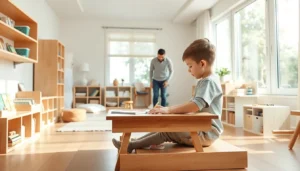
- The prepared environment: Spaces should match a child’s size and abilities. Low shelves, child-sized furniture, and accessible materials invite independence.
- Freedom within limits: Children choose their activities, but clear boundaries exist. A child can select any book from the shelf but cannot throw books across the room.
Montessori isn’t about permissiveness or chaos. It provides structure through environment design rather than constant adult direction. When a room is set up correctly, children naturally gravitate toward productive work.
Creating a Montessori Environment at Home
A Montessori environment prioritizes accessibility and order. Every item has a designated place, and children can reach what they need without asking for help.
Start with the spaces your child uses most. In the bedroom, place the mattress on the floor or use a low bed frame. This allows toddlers to get in and out independently. Hang clothes at child height and limit options to a few outfits, too many choices overwhelm young children.
The kitchen offers excellent opportunities for how to Montessori in daily life. Create a low snack station with healthy options your child can grab alone. Keep a step stool accessible so they can help with meal preparation. Child-safe knives, small pitchers, and appropriately sized dishes encourage participation.
For play areas, rotate toys regularly. Display five to seven activities on low shelves rather than filling bins with dozens of options. Each material should have a complete set, all puzzle pieces present, all blocks together. This teaches respect for materials and reduces overwhelm.
Organize activities from left to right on shelves, moving from simple to complex. This mirrors reading direction and subtly prepares children for literacy. Use trays or baskets to contain multi-piece activities. A child can carry the entire tray to a work space and return it when finished.
Natural materials matter in Montessori spaces. Wood, metal, glass, and fabric provide sensory variety that plastic cannot match. Real glasses break when dropped, and that’s okay. Children learn careful handling through natural consequences.
Essential Montessori Activities by Age
Montessori activities match developmental stages. What works for a toddler differs completely from what engages a preschooler.
Infants (0-12 months)
Babies need simple, high-contrast objects to track visually. Black and white mobiles work well in the first months. As grasping develops, introduce wooden rattles and fabric balls. A mirror at floor level supports self-recognition. Movement matters most during this stage, provide plenty of tummy time and floor freedom.
Toddlers (1-3 years)
Toddlers crave practical life activities. Pouring water between small pitchers develops coordination. Transferring beans with a spoon builds the pincer grip needed for writing. Simple cleaning tasks, wiping tables, sweeping with a child-sized broom, satisfy their desire to contribute.
Sensory activities also peak during these years. Sorting objects by color, matching textures, and identifying sounds all build neural pathways. Montessori puzzles with knobs strengthen the fingers for future pencil grip.
Preschoolers (3-6 years)
This age group handles more complex how to Montessori materials. Sandpaper letters let children trace letter shapes while learning phonetic sounds. Number rods introduce quantity concepts concretely before abstract math. Practical life expands to food preparation, plant care, and simple sewing.
Geography begins with puzzle maps. Children trace continent shapes and learn location through muscle memory. Science activities include caring for pets, growing plants, and simple experiments with magnets or water.
The key across all ages: follow the child’s interest. If a three-year-old ignores the letter materials but spends hours transferring water, honor that. The concentration built during water play transfers to academic work later.
Adopting the Montessori Mindset as a Parent
Materials and environment matter, but the parent’s approach matters more. How to Montessori successfully requires shifting adult habits.
First, slow down. Children operate on different timelines. A toddler putting on shoes might take ten minutes. Building that buffer into the schedule allows independence without stress. Rushing children undermines their developing competence.
Observe before intervening. When a child struggles with a puzzle, the instinct is to help immediately. But struggle builds problem-solving skills. Wait. Watch. Often, the child figures it out alone, and gains confidence from that success.
Speak less and show more. Instead of explaining how to fold a napkin, demonstrate silently. Exaggerate each movement. Then hand the napkin to the child without comment. This respects their intelligence and avoids overwhelming verbal instructions.
Offer limited choices. “Do you want the red shirt or blue shirt?” works better than “What do you want to wear?” Two options give children control without paralyzing them.
Accept imperfection. A child’s bed-making won’t look Pinterest-worthy. Their poured juice will spill. Process matters more than product. Praise effort and participation rather than results.
Perhaps most challenging: trust the child. Montessori philosophy assumes children want to learn, grow, and contribute. They’re not lazy or manipulative by nature. When behavior problems arise, Montessori parents ask what need isn’t being met rather than jumping to punishment.